What Is a Halal Snack Pack (HSP)? A Simple Guide
Written for anyone who has heard people rave about the HSP and wants to know exactly what it is, what’s inside it, where it came from, and how to order one you’ll actually enjoy.
The short answer
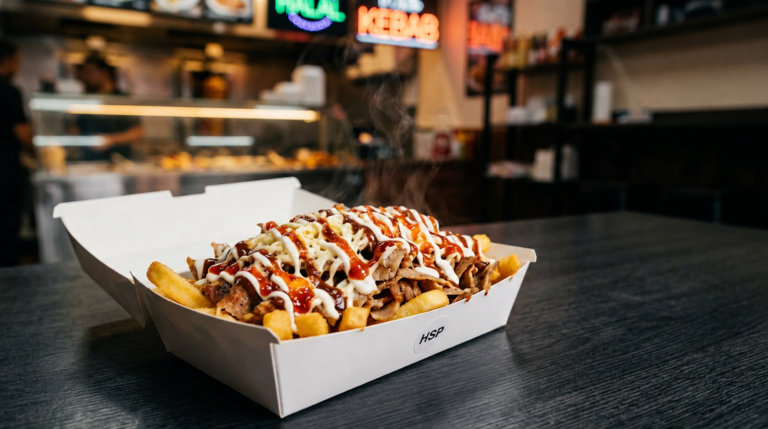
A Halal Snack Pack, almost always shortened to HSP, is an Australian fast-food dish made of hot chips topped with halal-certified doner kebab meat, a layer of sauces, and usually melted cheese. It comes served in a box or tray, and the meat is prepared according to Islamic dietary rules, which is where the “halal” in the name comes from.
That’s the whole idea in one sentence: chips, kebab meat, sauce, and cheese, piled into a box. Simple as it sounds, the HSP has become one of the most talked-about takeaway dishes in the country, with its own online fan communities, a place in the dictionary, and passionate regional debates about who invented it and what to call it.
Everything below explains the parts, the history, the regional names, the overseas cousins, and how to order a good one, so that by the end you’ll understand the dish completely and know exactly what to ask for at the counter.
What's actually in an HSP
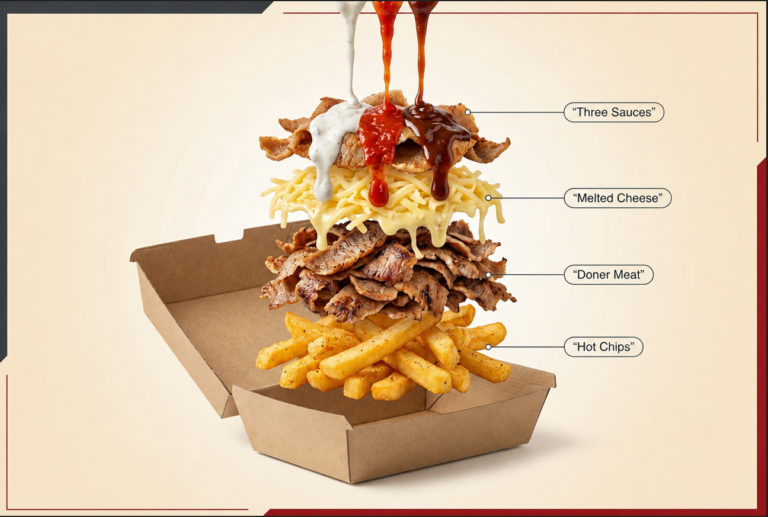
An HSP has four core layers. Most kebab shops build it the same way, from the bottom up, and understanding each layer helps you customise your order.
1. Hot chips. A generous bed of thick-cut chips (what Americans call fries) fills the base of the box. They’re usually fresh out of the fryer, hot and golden. The chips do more than bulk out the meal; they soak up the sauces and the juices from the meat, which is a big part of why the dish works so well. A good HSP has chips that are crisp on the outside but soft enough to carry all that flavour.
2. Doner kebab meat. A generous heap of thinly sliced meat, carved from a tall vertical rotisserie, goes on top of the chips. This is the star of the dish, and it’s the part you usually get to choose: chicken, lamb, beef, or a mix of them. The meat is stacked and slow-cooked on a spinning skewer, then shaved into thin strips to keep it juicy. This is also the halal-certified component that gives the dish its name.
3. Cheese (optional but common). Many shops add grated cheese over the hot meat so it melts down through the layers. The heat from the freshly carved meat and chips softens the cheese into a rich, gooey layer that binds everything together. Cheese is widely considered the signature Australian touch on the dish, and it’s one of the main things that separates the HSP from traditional Middle Eastern meat-and-chip plates. That said, it’s entirely optional, and plenty of people order theirs without it.
4. Sauces. The dish is finished with sauce, and traditionally that means three of them: garlic, chilli, and barbecue. This combination is so iconic that it has earned a nickname, the “holy trinity.” Each sauce plays a role: garlic sauce is creamy and tangy, chilli brings the heat, and barbecue adds a sweet, smoky depth. Together they cut through the richness of the meat and cheese. Some shops offer additional or alternative sauces, and depending on where you are, you might also see yoghurt sauce, jalapeños, or tabbouleh added on top.
Put those four layers together, and you get a hot, filling, deeply savoury box of food that’s easy to share or happily demolish on your own.
At a glance
| Layer | What it is | Notes |
| Chips | Thick-cut hot chips | Forms the base; soaks up the sauces |
| Meat | Doner kebab meat | Chicken, lamb, beef, or mixed; halal-certified |
| Cheese | Grated, melted cheese | Optional; the classic Aussie addition |
| Sauces | Garlic, chilli, barbecue | The famous “holy trinity” |
A closer look at the meat choices
Because the meat is the part you choose, it’s worth knowing how the options differ so you can pick what suits you.
Chicken is the mildest and leanest option. It has a lighter flavour that lets the sauces come through, and it’s usually the go-to for anyone who finds red meat too heavy. Lamb is the richest and most traditional, with a deeper, more savoury flavour that stands up well to the sauces. Beef sits in the middle, hearty but not as strong as lamb. And mixed, which combines two or more meats, gives you a bit of everything and is one of the most popular choices for exactly that reason.
If you’ve never had an HSP before and can’t decide, mixed meat is a safe, satisfying starting point that shows off the range of flavours in one box.
Why is it called "halal"?
The “halal” in Halal Snack Pack refers to the meat. In Arabic, halal means “permissible” or “lawful,” and in the context of food, it refers to ingredients that meet Islamic dietary requirements. The opposite term is haram, meaning forbidden.
For meat to be considered halal in Australia, it generally needs to come from an animal that was healthy at the time of slaughter, slaughtered in a specific manner that includes reciting a prayer, and handled according to Islamic guidelines. Certain foods, such as pork, are never halal under any circumstances. In Australia, halal certification is carried out by several recognised Islamic organisations that audit and approve suppliers and premises, checking ingredients, processing methods, and handling before granting certification.
A useful piece of context: Australia’s halal meat system is closely tied to a very large export industry, and meat certified for export is subject to Australian Government oversight through what are called Approved Islamic Organisations. Certification that serves only the domestic market is less centrally regulated, allowing standards to vary among certifiers. It’s also worth knowing that most halal slaughter in Australia involves pre-slaughter stunning for animal welfare reasons, though there is ongoing discussion within the Muslim community about that practice.
The practical takeaway for ordering: the word “halal” in the dish name tells you the kebab meat is prepared to Islamic standards. But if eating strictly halal matters to you for religious reasons, it’s still worth confirming a specific shop’s certification rather than assuming, because the name of the dish describes a style of food, not a guarantee about any individual store’s sourcing.
A Note About Halal Compliance
This guide explains halal in general terms and is not religious guidance. If halal compliance is important to you for religious reasons, please verify the individual shop’s certification and, where appropriate, consult a trusted religious authority.
Where the HSP comes from
The HSP is genuinely Australian, and its story mirrors the country’s own multicultural history. It grew out of the kebab shops opened by Middle Eastern immigrants, combining doner kebab meat with local favourites like chips and cheese. Kebab shops have existed in Australia since roughly the 1960s and spread widely through the 1980s, and versions of “meat and chips in a tray” were quietly sold on shop menus for decades before the dish ever had a famous name.
Australia’s claim to have created the dish is rarely disputed. The main reason is the cheese: traditional Turkish and Lebanese meat-and-chip plates don’t typically include it, so the melted-cheese version is understood to be a distinctly local invention. What began as a practical, filling feed for late-night customers gradually turned into something with its own identity.
The name “Halal Snack Pack” then exploded into mainstream awareness around 2015 and 2016. A Facebook group called the Halal Snack Pack Appreciation Society grew to well over 100,000 members and turned the dish into a shared national obsession, with members photographing, reviewing, and rating snack packs from shops all over the country. Around the same time, the dish became a talking point in national politics during debates about halal certification, which only raised its profile further. In 2016, “halal snack pack” was voted the Macquarie Dictionary’s People’s Choice Word of the Year, cementing its place in the Australian vocabulary.
Part of the enduring appeal of the HSP is exactly this backstory. It’s a dish created when unrelated food cultures were brought together and combined into something new, which many people see as a small, delicious symbol of modern Australia itself.
The many names for an HSP
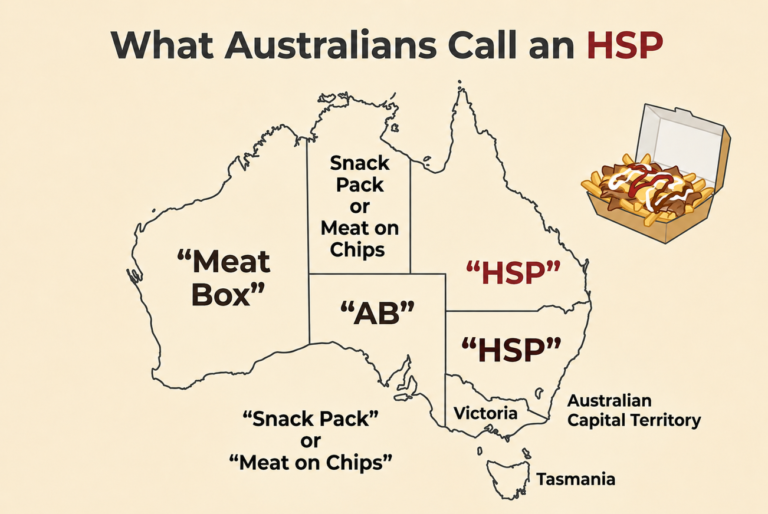
One of the quirks of this dish is that what you call it depends on where you are in Australia.
1. HSP — the standard name across most of the country, especially the eastern states.
2. AB — what it’s called in Adelaide and much of South Australia. Locals there argue the dish is actually an Adelaide invention that predates the “HSP” name, and two North Adelaide burger shops both claim to have created it decades ago. The letters stand for a piece of crude local slang, which is why most menus print “AB.”
3. Meat box — the common term in Western Australia, particularly around Perth.
4. Snack pack, meat on chips, and kebab plate — used loosely in various places. “Meat on chips” is also the typical name across the Tasman in New Zealand.
The Adelaide debate is a good example of how seriously people take this dish. When the eastern states began celebrating the “HSP” online, many South Australians were baffled, insisting they’d been eating the same thing as an “AB” since well before the newer name caught on. Both North Adelaide shops that claim the invention still stand by their stories, and the friendly rivalry has become part of the dish’s folklore.
How to order an HSP you'll actually enjoy
If you’ve never ordered one, here’s how to get a great result rather than a soggy disappointment.
Pick your meat. Chicken is milder and leaner, lamb is richer and more traditional, beef sits in between, and “mixed” gives you a bit of everything. If you can’t decide, mixed is a safe and popular choice that covers all bases.
Decide on cheese. Cheese adds richness and helps bind the box together into that classic gooey texture. If you want the full traditional experience, keep it on. If you’d rather keep things a little lighter, ask for no cheese; no shop will blink at the request.
Choose your sauces carefully. The classic combination is garlic, chilli, and barbecue. If you don’t like heat, skip the chilli. If you love garlic, this is very much the dish for it. Most shops let you choose, so speak up rather than defaulting, and don’t be afraid to ask what house sauces they offer.
Pick a sensible size. HSPs are usually generous. If it’s a meal for one, a small or medium is often plenty. Larges are genuinely large and are great for sharing between two people or for a serious appetite after a long day.
Ask about sauce placement if it matters to you. Some people love the sauce mixed all the way through so every chip is coated; others prefer it drizzled on top so the chips underneath stay crisp for longer. A quick word at the counter can make a real difference to the final result.
A few practical tips
- Eat it fresh. An HSP is at its absolute best straight away, while the chips are still crisp and the cheese is melted and stretchy. It doesn’t travel well and doesn’t reheat well, because the chips go soft once the sauce and steam sit on them. If you’re taking it home, eat it the moment you arrive.
- It works as a shared dish. In some places, especially Adelaide, the pack is placed in the middle of the table and shared straight from the box. It’s naturally suited to this, so it’s a good pick when you’re with friends.
- It’s a treat, not an everyday meal. Between the fried chips, the meat, the cheese, and the sauces, an HSP is high in energy and fat. It’s a satisfying occasional feed rather than a light lunch, and it’s most enjoyed exactly that way.
- Lighter tweaks are possible. If you want to lighten it up a little, you can ask for less sauce, skip the cheese, choose chicken instead of lamb, or share it. None of these changes the spirit of the dish, but they do make it a bit more balanced.
The bottom line
A Halal Snack Pack is one of Australia’s most beloved late-night and takeaway dishes: hot chips, halal doner meat, cheese, and the classic garlic-chilli-barbecue sauces, all layered into one box. It’s filling, endlessly customisable, and carries a genuinely Australian story of different food cultures combining into something new and uniquely local.
Now that you know what’s inside it, why it’s called halal, where it came from, and how to order one that suits your taste, the only thing left is to try it for yourself.
Your HSP Questions, Answered.
From the classic layers and sauce choices to halal guidance and ordering tips, find quick answers before you build your perfect snack pack.
Frequently Asked Questions
Tap a question to reveal the answer.